
How EcoBeautyScore measures environmental impact
The full journey from product to score
How We Measure Impact
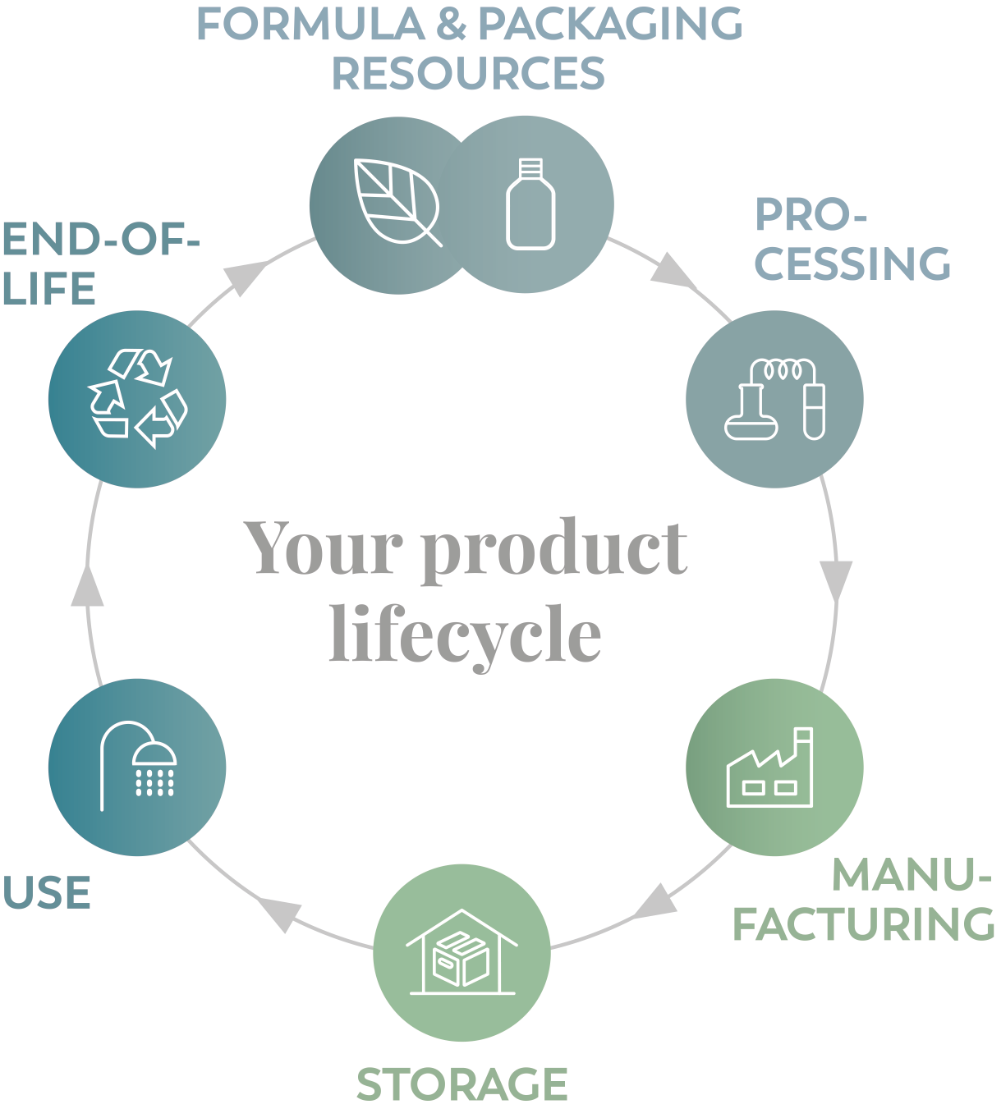
A cosmetic product's environmental footprint doesn't come from a single ingredient or a single decision. It accumulates across six distinct stages - from the fields and facilities where raw materials are sourced, the processing of those raw materials into ingredients & packaging components, the manufacturing of the product, distribution & storage, right through to the moment of use and what happens to the product after it’s used. EcoBeautyScore maps every one of those stages, evaluates them against 16 planetary impact indicators, and distills the result into a single A–E rating.
The scoring system is built on the Product Environmental Footprint (PEF) framework developed by the European Commission, and aligned with ISO 14040 and 14044 lifecycle assessment standards. It's a quantitative, evidence-based approach that gives a full picture of where a product's footprint comes from.
The sections below break down each of the six life cycle stages and explains the 16 planetary impact indicators that are measured at each stage.
The 16 planetary impacts we measure
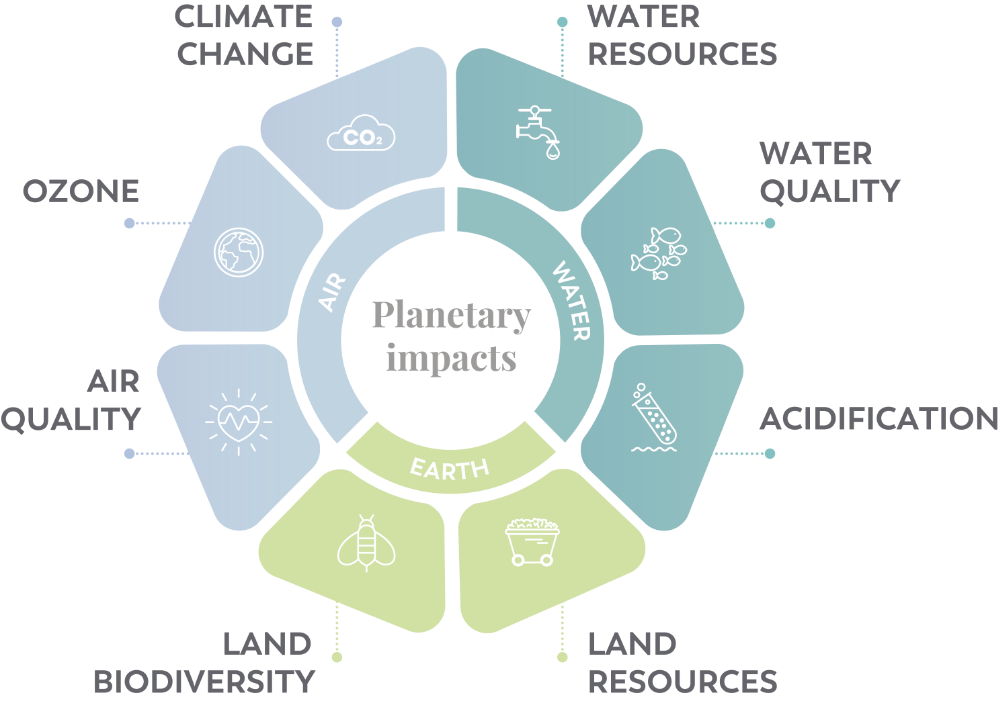
A product's environmental footprint isn't a single number - it's the sum of many different effects on the planet. EcoBeautyScore uses the European Commission's set of sixteen Product Environmental Footprint indicators, the same set the EU recommends for evaluating any product's environmental performance.
We've grouped the sixteen indicators into three themes for easier reading. Each tab below contains the indicators belonging to one theme, with a short explanation of what each measures and where the impact tends to come from in a cosmetic product.
The four indicators in this group measure how a product affects the atmosphere - both the gases that drive long-term climate change and the pollutants that affect the air we breathe day to day. For most cosmetics, the impact in this group is driven by energy used to grow and process ingredients, transportation of finished goods, and heating the water consumers use during application..
Climate change - The most familiar of the indicators: total greenhouse gas emissions across the product's life cycle, expressed in kilograms of CO₂-equivalent. This rolls together carbon dioxide from energy and transport, methane from agriculture (palm, coconut, dairy-derived ingredients), and nitrous oxide from fertiliser use. For many rinse-off cosmetics the largest single contributor is the hot water consumers use during application at home - often more than the manufacturing itself. Should the use-phase be excluded, though, climate remains one of the main contributing impact categories.
Ozone depletion - Damage to the stratospheric ozone layer, the part of the upper atmosphere that filters out harmful UV radiation. Measured in kilograms of CFC-11 equivalent. Modern cosmetic formulations rarely contain ozone-depleting substances directly, but small impacts still appear through cooling agents and propellants used during ingredient production and packaging manufacture.
Photochemical ozone formation - Ground-level smog: the haze that forms when volatile organic compounds (VOCs) and nitrogen oxides react in sunlight. Unlike stratospheric ozone, this is harmful at the level we breathe, contributing to respiratory disease and crop damage. Sources include solvent and fragrance evaporation, transport emissions, and certain manufacturing processes.
Particulate matter - Fine airborne particles small enough to enter the lungs and bloodstream, linked to heart and lung disease worldwide. The indicator measures emissions of PM2.5 and its precursors across the supply chain. Combustion-heavy steps - energy generation, freight transport, certain raw-material processes - are the main contributors.
Product Segments
EcoBeautyScore is designed to apply to all cosmetic products, enabling like-for-like comparisons based on environmental impact. To achieve this, all cosmetic products are grouped into 31 segments based on their primary consumer benefit.
For example, all products that clean the hair (shampoos) are placed in a single segment, allowing consumers to choose lower-impact alternatives within the same category.
By the end of 2026, the EcoBeautyScore aims to cover the product segments below in green. Additional segments will be introduced over time, with the aim of covering all cosmetic products across global markets.
1.0. HAIR
1.1. HAIR WASH
1.2 RINSE-OFF HAIR CARE
1.3 SCALP TREAT
1.4 SHAPE & REFESH
1.5 TRANSFORM
1.6 COLOUR
1.7 LEAVE-IN HAIR CARE
2.0 FACE CARE
2.1 CLEAN & REMOVE
2.2 MOISTURISE & TREAT
2.3 UV PROTECTION
2.4 BOOST
2.5 EYE
2.6 LIP
3.0 BODY CARE
3.1 BODY WASH
3.2 CORRECT ODOURS
3.3 MOISTURISE & TREAT
2.4 BATH
3.5 UV PROTECTION
2.6 BOOST/OTHER
4.0 DECORATIVE COSMETICS
4.1 EYES
4.2 LASHES & BROWS
4.3 FACE
4.4 LIPS
4.5 NAILS
4.6 HAIR
4.7 NAIL COLOUR REMOVAL
5.0 ORAL CARE
5.1 CLEAN & PROTECT
5.2 FRESHEN & PREVENT
5.3 AESTHETICS & CARE
6.0 FRAGRANCE
6.1 PERFUME
7.0 GROOMING
7.1 HAIR REMOVAL
Scoring
EcoBeautyScore grades are always comparative within a segment - an A-graded shampoo is being judged against other shampoos, not against moisturisers or fragrances. The five grades describe where a product's environmental footprint sits on a scale built from a sample of representative products in that segment.
Products in the top 10% of their segment for environmental performance. To reach an A, a product needs to be performing well across the 16 PEF impact indicators - not just one. In practice that is likely to mean ingredients made using lower-impact processes, formulations that are less harmful to the environment, packaging that includes recycled materials and designed to be easier to recycle, for example by reducing unnecessary components or layers.
Standards, Review & Validation
Independent review, third-party verification, international standards, and two rounds of public consultation. How we know the methodology stands up.
Scientifically-recognised methodology
PEF / European Commission
Built on the European Commission's Product Environmental Footprint (PEF) methodology — the EU's recommended standard for measuring the environmental performance of products across their full life cycle. PEF is the most rigorous and policy-aligned framework available for this purpose, and it forms the technical foundation for everything EcoBeautyScore measures.


Independent Verification
Ecocert / E&H
The EcoBeautyScore methodology and platform have been reviewed and verified by E&H, the consulting branch of the Ecocert group, to ensure compliance with the principles of the European Commission's PEF methodology and the international standards governing environmental labels and declarations (ISO 14020/14025). Ecocert is one of the most recognised sustainability certification bodies globally.
External Certification
By one of our three certifying bodies
Brands wishing to publish their EcoBeautyScore must complete an external audit with one of several approved certifying bodies before communicating results. This independent verification step is required under the EU Empowering Consumers Directive and provides an additional layer of trust and credibility to the scores.


Regulatory-Ready
Built with regulations in mind
The EcoBeautyScore system was developed with current and evolving regulatory requirements in mind. Its PEF-aligned methodology supports alignment with regulations such as the EmpCo/ECGT Directive. Through partnerships with major trade associations and regular contact with regulatory authorities, EcoBeautyScore monitors evolving expectations around substantiation, transparency and verification.
Approach
The EcoBeautyScore methodology was developed by LCA specialists and cosmetics industry experts under the guidance of an independent environmental consultancy. It has been reviewed by an external panel of LCA experts, subjected to two rounds of public consultation, and verified by E&H, the consulting branch of the Ecocert Group.
The process of developing a scoring system such as this should be one of continuous improvement. EcoBeautyScore will therefore continue to work closely with E&H to improve and evolve the methodology, database and data sources in line with scientific progress and the recommendations made during the above methodology reviews.